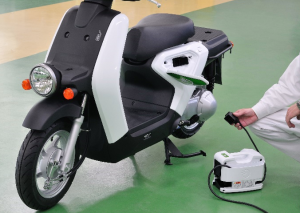
The proliferation of e-scooters underscores the need for new battery-management schemes. Battery advancements are leading to a new generation of clean, affordable, low- and mid-speed electric vehicles. As electric cars, trucks, and SUVs built by some of the top automakers grab headlines, another rapidly growing electric-vehicle market segment is frequently overlooked. Low- and medium-speed EV sales — including that of e-motorcycles and e-scooters — are skyrocketing, benefitting from advancements in various EV technologies, particularly longer-lasting battery packs.
According to a recent report by Global Market Insights, the e-motorcycle and e-scooter market size was valued at US$30 billion in 2019 and is estimated to grow at a compound annual growth rate of more than 4%, reaching US$40 billion by 2026. This growth is not restricted to two-wheelers, either, but also extends to a variety of lower-voltage–range EVs like electric skateboards and ATVs.
The circle of LiFe
Batteries, often based on lead acid (PbA chemistry), have been used for quite some time to power small e-vehicles and e-bikes for green, eco-friendly transportation. But the search for a battery chemistry with less of an environmental impact and a lower weight — which translates into an e-bike that is safer to maneuver and stop — is most responsible for accelerating the drive toward the widespread use of lithium-based (Li-ion or LiFePO4, for instance) battery technologies in light EVs.
In China, this transition was made official in April 2019, with the GB 17761-2018 standard covering complete bicycle safety (including electronics). Other countries, like India, are working on similar local standards to limit the registration of new e-bikes by size, speed, and battery type. Notably, new e-bikes being registered for license plates must have a maximum speed of 25 km/h, lithium batteries, and the ability to attach pedals.
As we move toward a future full of flying cars and hoverboards, Li-based batteries mostly set the standard, which makes increasing their utility and ensuring they are safe an absolute must. This is where an effective battery-monitoring solution can help.
Monitoring with a purpose
You may ask: What kind of battery-monitoring solution is able to give battery pack engineers peace of mind and keep urban explorers safe? That would be a solution that considers cell voltage, current, and temperature. Accuracy in measuring these parameters helps the monitor determine when to activate its protective capabilities, giving engineers more leeway and headroom in their designs, thereby allowing for larger battery capacity and extended range.
To protect the battery and overall system — both of which are evaluated against various industry standards and regulations — the battery must be disabled whenever the cell temperature, the input voltage, or the current are outside its specified range of the cell.
Let’s first look at temperature. At lower temperatures (below 5°C), Li-based batteries do not work as well and are often prevented from operating or charging. At higher temperatures (greater than 45°C), the battery is not allowed to charge beyond a moderate temperature and is prevented from discharging as the temperature rises higher.
There’s also the risk of thermal runaway, which could result in swelling of the battery and potentially an explosion. This is where battery-monitoring devices with thermal management capabilities come in handy.
For example, the temperature-measurement capabilities featured in BQ76942 and BQ76952 allow us to keep track of internal die temperature and external thermistor temperatures as well. The integrated thermal-protection features can also disable charging and/or discharging automatically when temperature extremes are detected.

Now that we’ve ensured our battery won’t burst into flames as a result of poor thermal management, we can start monitoring the parameters that can really help optimize battery efficiency and lifetime. This is where our current and voltage monitoring help us triage. If we happen to detect that the open-circuit voltage of a cell is higher than its rated charge voltage, the device will identify this as cell overvoltage (a phenomenon that expels the excess potential energy as heat) and disable further charging from occurring. From a preventative standpoint, the device can disable charging or discharging by controlling protection switch FETs using the integrated FET drivers.
Ultimately, the ability to accurately monitor cell currents and voltages in tandem with temperature proves to be a great tool to know that your battery and vehicle are safe to operate.
Future outlook
Choosing an e-bike battery-monitoring solution that prioritizes the safety of its users and battery longevity should be standard in any design. That’s why a solution that actively monitors cell temperature, voltages, and current is the ideal choice.
Moreover, these advanced battery-monitoring and battery-management technologies alongside the optimization of battery-production processes promises to further increase environmental benefits of adopting electric transportation.
We may not need roads where we’re going, but we’ll certainly need safe batteries.