Often users do not pay enough attention to power supplies for smartphones and tablets, but they are important devices. They ensure the correct charge of the batteries and their quality also determines the duration and average life
Often, users do not pay enough attention to power supplies for smartphones and tablets, but they are important devices. They ensure the correct charge of the batteries, and their quality also determines the duration and average life of the rechargeable elements. The market offers a wide range of power supplies at any price, from $1 to hundreds of dollars. Let’s see what the real differences are, focusing our attention on the Samsung and Apple brands.
The power supply function for small devices
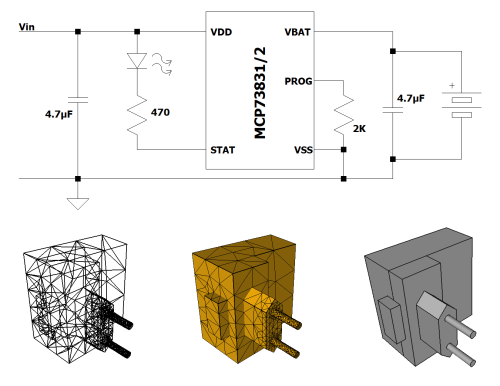
A battery charger is a very compact switching power supply, which converts the AC line (230 V or 110 V) into a 5-VDC output. The AC input is converted to high-voltage DC, then switched and fed into a small transformer. Finally, the output is converted to 5-V filtered low-voltage DC via the USB port. Depending on the quality, the residual ripples can change. Small devices (tablets and smartphones) are becoming more and more powerful and require an ever-higher current for their operation and charging. It is therefore important to have an energy source that is always ready for use. The market offers different models, more or less compatible with the devices and with different charging speeds. There are thousands of solutions on the market today and there are many wiring diagrams, from the least efficient to the most complex, which are able to successfully recharge lithium batteries. Figure 1 shows one of the many possible solutions.
Some sophisticated power supplies also carry some digital information through the USB cable, as well as power. For this reason, some smartphones work only with their own charger. In the end, there is no better and no worse current. Only the control systems, supply systems, and safety systems change; it is the latter that causes prices to rise. Many smartphone models, especially the most recent ones, are available without the need for power supply. This makes it clear that companies let users choose their recharging tool. This strategy was followed for several reasons:
- Savings in packaging (now smaller and cheaper)
- Respect for the environment
- Shipments with a higher number of devices
- Cheaper products
All chargers on the market have electrical features (watts or ampere-hours). Therefore, it is always best to check the manufacturer’s specifications before buying a charger. An inexpensive model will hardly be able to supply much current and could easily overheat and burn out. To be on the safe side, we recommend a 5-V model and at least 2 A, for maximum compatibility with almost all smartphones. Obviously, the current will be supplied according to the connected device. The fundamental formulas for the calculation of various quantities are linked to Ohm’s law and, leaving out the losses due to the “non-perfection” of the materials, they are as follows:

Inside a charger, there are more or less complex circuits, all packed up in a very small space. The small size increases the difficulties in making an efficient and high-quality charger. The large market demand leads manufacturers to produce simpler circuits with less expensive components, and devices are less pricey but poor-quality. Obviously, the user cannot evaluate the performance of the device from the outside. If the power supply is poor, various problems may arise. If the output voltage is not filtered properly, the noise and ripples could damage the phone and the touchscreen would not work. In addition, a decrease in voltage may occur as the load increases and the charging time may drastically increase as well.
Samsung and Apple, compared
The two giants approach the problem of the battery charger in a slightly different way. Apple unpacked the power supply, leaving only the “Lightning USB Type-C” cable, arguing that nowadays, all users have their own chargers and that they create polluting waste. Furthermore, by removing the charger from the package, ultra-fast charging could be transformed into a paid option. Today, the real difference is in the variety of cables and connectors. Each manufacturer is trying to create some sort of monopoly, even if the market is pushing for a global standardization of connections.
The good thing about today’s technology is that connectors are standard, for the most part. Users can choose from a wide range of products. All the major manufacturers (except Apple) adhere to the micro-USB Type-B standard (and recently also the Type-C), and it is now possible to charge the phone with any type of charger. Starting with the iPhone 8, Apple iPhones can be charged quickly via the USB Power Delivery standard. A matching charging cable is required to connect the iPhone to the USB-C socket on the power supply via its Lightning socket. A reliable test of a power supply must be done in the laboratory.
In fact, Apple and Samsung products have excellent quality, but if you buy a USB charger, it is not possible to determine the real quality by examining only the device from the outside and simply reading the plate data. It cannot be established whether the power supply is well-leveled and continuous or has oscillations and noise by simply looking. It is necessary to examine the largest number of models and carry out many in-lab tests, using precise and sophisticated instrumentation.
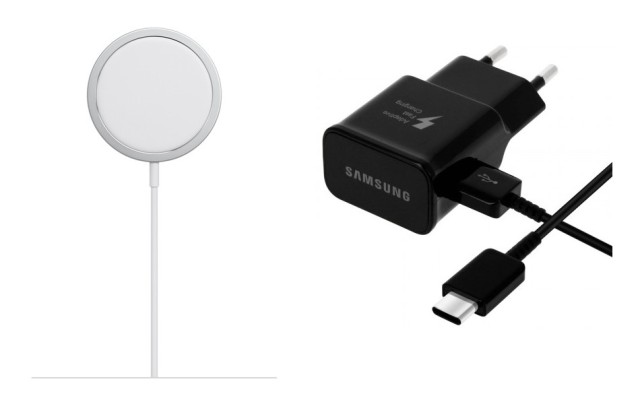
A very simple test that everyone can do is to carry out a quick recharge (for smartphones that provide it) from 20% to 80% and check the time it takes and the temperature on the back side of the device, which is in close contact with the battery. In Figure 2, you can see some charging solutions for Apple and Samsung.
As for Apple, the MagSafe power adapter for wireless charging is extremely convenient today. The built-in magnets align perfectly with the iPhone 12 or iPhone 12 Pro, to charge faster with up to 15 W of power. The MagSafe power adapter is compatible with Qi charging and can be used for models from iPhone 8 on and the models of AirPods with wireless charging case. We recommend pairing it with a 20-W USB-C power supply. As for Samsung’s Galaxy S21, the company recommends using an original Samsung battery, charger, and Type-C cable designed for the Samsung device. The use of incompatible batteries, chargers, and cables could cause serious and even permanent damage to the device. It is possible to charge the battery more quickly using the “quick charge” or “ultra-fast charge” function, which can be configured and activated directly from the device.
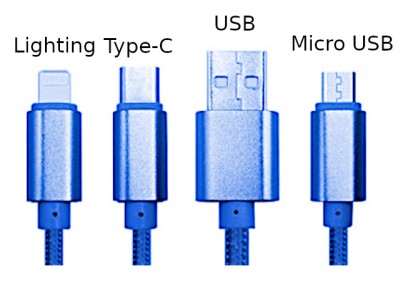
One of the critical factors that consumers tend to ignore is related to the connection cables (see Figure 3). They must be very high-quality. They often tend to break, intertwine, and detach, especially in the poorest products. All devices charge via USB, although there is a different connector, depending on the version. For Apple products, there is the Lightning socket. Most Android smartphones and tablets use standard micro-USB connectors instead. Today, the new standard is USB-C connection, which is similar to micro-USB but with a slightly different socket. It can be oriented on both sides.
Power Delivery, the standard for fast charging
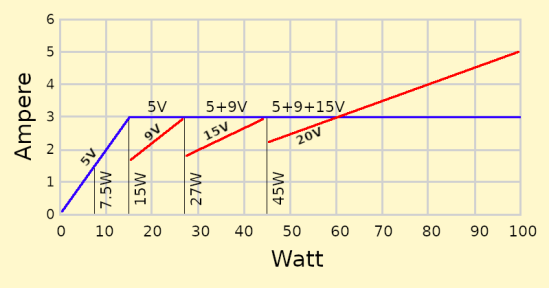
Apple uses the Power Delivery standard, universally recognized by all manufacturers. Power Delivery is a set of specifications for universal USB Type-C chargers that can deliver power between 0.1 W and 100 W. The cable has a major impact: A 3-A cable can handle up to 60 W, while a 5-A cable can handle up to 100 W. A compatible Power Delivery charger adapts to the request of the connected device dynamically, modifying the voltage and current values supplied (see graph in Figure 4). This allows you to adjust the best dispensing procedure in relation to the battery charge and temperature. If the battery is empty, it requires more amperes; if the battery is almost full, on the other hand, charging will be very slow in order not to damage the accumulators. The battery charger adjusts to the condition of the battery. If you use a third-party charger, you will not be able to reach the maximum speed because it “does not recognize” the smartphone connected to it. To understand which profiles are supported, it is very important to read the label of the charger supplied.
Compatible charger for Samsung and Apple
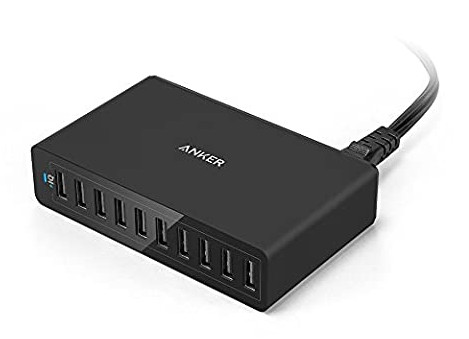
Users can now successfully choose Anker wall chargers, equipped with many USB ports and with Power IQ fast-charging technology, compatible with iPhone, iPad, Samsung Galaxy, and others. The proprietary Anker Power IQ technology automatically identifies the device and maximizes its charging speed, offering the fastest-possible solution. Through the numerous USB ports, you can charge smartphones and tablets simultaneously. Some models also have 10 USB ports, such as the Anker PowerPort 10 model shown in Figure 5. This type of charger allows you to generate a lot of power for a simultaneous charge of a large number of devices. In addition, the numerous overcurrent and high-temperature protections keep the devices safe, with high efficiency (DOE 6). They are compatible with iPhone, iPad, and Android smartphones and tablets (including the Nexus 7).
Conclusion
The charger must be compatible with this technology to charge quickly; otherwise, charging will take longer. Fast charging, in fact, reduces the battery’s life. The reduction in recharging times causes a slight heating of the components and elements, and in general, lithium prefers to work in the cold. In any case, an adequate cooling system of the batteries should avoid this problem. A generic USB charger can be used to charge a smartphone. The important thing is that it supplies an amount of current equal to or greater than that of the original charger. Conversely, you cannot use a charger with a higher voltage because it can cause irreparable damage to the device. Increasing the amperage of the charger has no relevance, because the smartphone will draw only the current it needs. In this case, if we use a charger of 5 V and 200 A, there is no risk of damaging the device. When purchasing a charger, you must, of course, make sure that it works with your phone. It is also advised not to purchase a counterfeit charger. Even though its price is extremely low, it is never convenient to take risks. An original charger, on the other hand, allows you to charge the battery at maximum speed, because inside, there is a chip with firmware that controls the connected device.